Independent speculative concept · Digital fashion experience
The Castle Opens Online
Under the Castle is a limited-time physical event for Halloween organised by a big fashion brand. This speculative case study explores how a digital layer could let international audiences enter that world, participate in its atmosphere, and stay connected—without reducing it to a conventional online store.
RoleProduct Strategy · UX/UI Design · Creative Direction
StatusConcept development · Representative prototype
Scroll
Independent speculative concept created for portfolio and exploratory purposes. This project was not commissioned, endorsed or approved by TEAM WANG design, Jackson Wang or Under the Castle. All referenced trademarks and existing brand assets belong to their respective owners.
01 — About the project
A physical experience. A wider digital question.
Under the Castle is an existing physical Halloween entertainment experience associated with TEAM WANG design. Its atmosphere, setting and limited availability make it distinctive. The representative prototype tests one complete attraction inside a progressively changing Living Park.
My contribution
I independently defined the product opportunity, experience loop, wireframes, visual system and representative prototype. AI tools supported environmental exploration; I directed, selected and refined the outputs before integrating them into the product experience.
Core product promise
UTC Digital gives international fans who cannot attend the physical UTC experience a way to enter, participate in and feel connected to its universe through an interactive digital journey—not merely observe it through content or encounter it as an ordinary online store.
Primary audience hypothesis
An existing Jackson Wang or TEAM WANG fan who already knows and cares about Under the Castle, cannot attend or is not attending the physical experience, and is visiting UTC Digital for the first time.
The representative journey demonstrates activation and participation—not new-audience acquisition.
02 — Brand context and observed opportunity
Understanding the world before extending it.
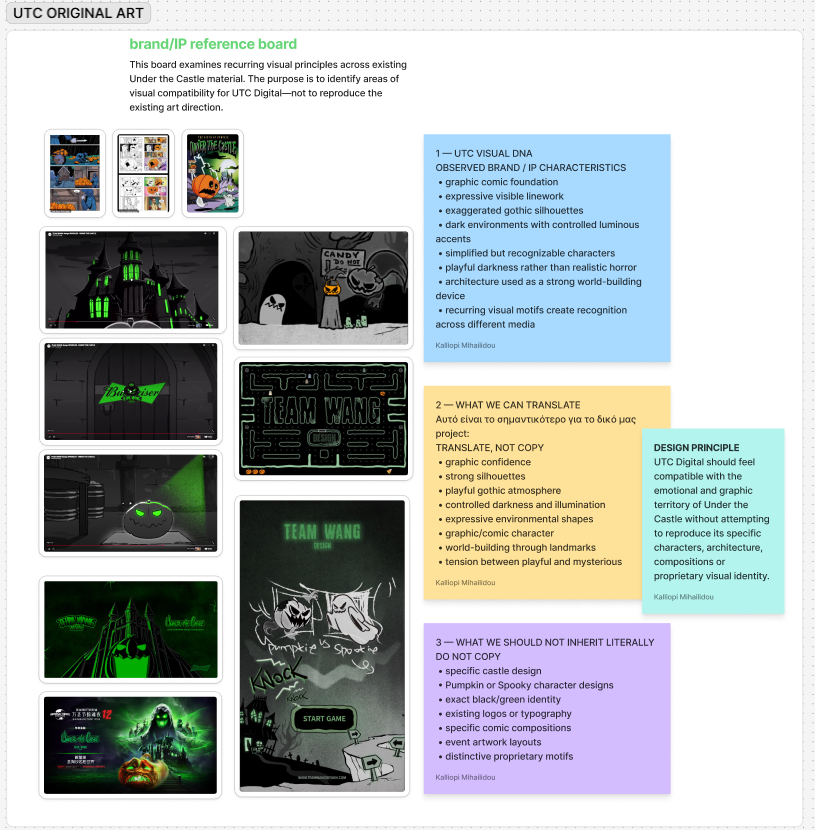
Independent analysis of the existing brand context—not an official TEAM WANG strategy document.
01 — Atmospheric identity
Theatrical darkness, Halloween references and immersive presentation make the experience feel like a distinctive world rather than a conventional retail release.
02 — Scarcity carries value
Time-limited physical access creates anticipation and exclusivity. A digital extension should widen participation without casually removing that value.
03 — Commerce is not the experience
If the digital layer begins with products rather than participation, it risks reducing the world to a conventional online store.
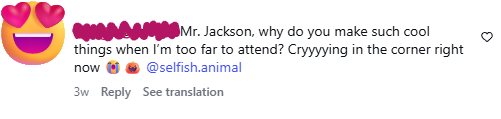
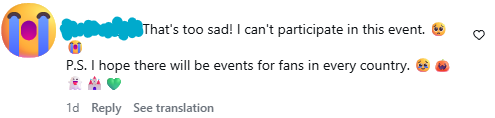
Two public Instagram comments expressed the same practical barrier: fans wanted to participate but were unable to attend because of location or access.
These comments informed an early opportunity hypothesis. They are qualitative examples—not evidence of validated demand or a representation of the wider audience.
Two anonymized public comments found on the official Under the Castle Instagram account in August 2026. They informed an early opportunity hypothesis but are not representative user research or evidence of validated demand.
Extend access to participation—not unrestricted access to everything—while preserving atmosphere, discovery and earned progression.
03 — Product strategy and business hypothesis
Expand participation. Preserve distinction.
Could Under the Castle preserve its limited-time character while giving international fans a meaningful way to participate beyond the physical event?
Concept hypothesis
UTC Digital could operate as a parallel, time-limited experience widening participation through play.
Three strategic hypotheses
01
Access beyond location
During the same limited event window, a browser-based experience may allow international fans who cannot attend physically to participate in the UTC universe.
02
Participation before promotion
A playable experience may create a stronger sense of involvement than passive campaign content or a conventional online store.
03
Value beyond transaction
Progression and completion should provide value independently, while admission and optional collectibles remain supporting commercial layers.
Business assumptions to validate
Access model
A meaningful free introduction could help visitors understand the proposition before deciding whether to enter the complete experience through one standard digital admission.
Secondary commercial layer
Limited-edition collectibles could provide optional progression-linked value without becoming the main purpose of participation.
Reusable platform
UTC Digital could return as a distinct annual chapter, allowing the platform to evolve while retaining the event’s limited-time character.
Commercial viability remains untested. Pricing, demand, production quantities, eligibility rules and financial forecasts would require validation with business, finance, production, technical and legal specialists.
04 — UX and experience loop
One visit. One complete loop.
01 — Enter
Brief gateway
Give the visitor enough context to understand the opportunity, then make entering the experience the dominant action.
02 — Play
Guided participation
Teach the first objective through interaction and give the visitor meaningful control quickly.
03 — Progress
Visible consequence
Confirm that the action mattered through candies, completion feedback and a visible change in the world.
04 — Unlock
Earned access
Reveal the unlock automatically, connect it to achievement, then let the visitor enter deliberately.
05 — Own
Optional ownership
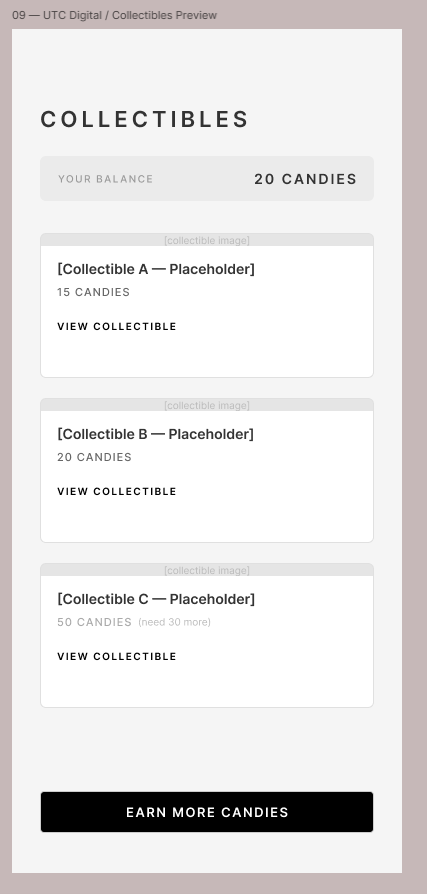
Acknowledge achievement before presenting a genuine choice between viewing collectibles and continuing to play.
06 — Return
A changed world
Return the visitor to the Living Park, reveal what has opened next and leave one visible future opportunity.
Experience principles
Guide through action
Participation begins through the experience itself.
Make progress unmistakable
Mystery may surround what comes next, but not whether an action mattered.
Protect player agency
Achievement comes before transaction; optional ownership must never become the purpose of play.
Create a reason to return
Return through a changed world and visible next opportunity—not commerce alone.
Living Park progression
First visit
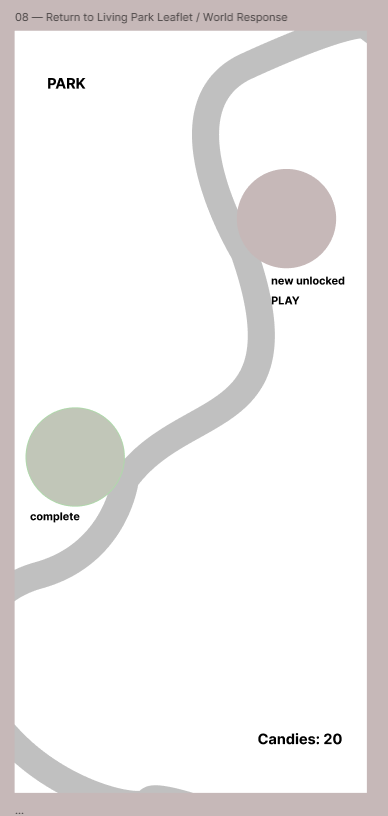
Only the available destination is fully revealed. Localized darkness and fog conceal future attractions while silhouette, framing, contrast and light keep the active route readable.
→After completion
The completed attraction changes state, fog recedes locally and the next route comes alive. The environment—not a conventional level menu—becomes the primary carrier of progress.
Key UX decision
The Living Park Leaflet is not a conventional level-selection screen. It is a progressively changing world that makes player progress visible.
05 — Representative game interaction
One simple challenge. A visible effect on the world.
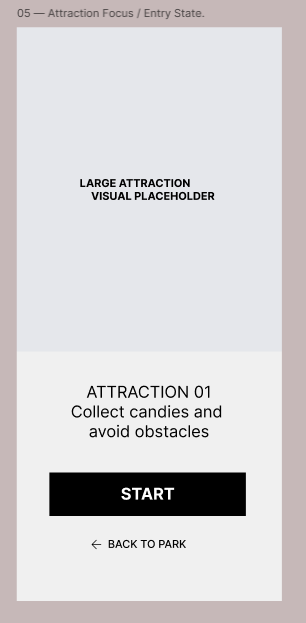
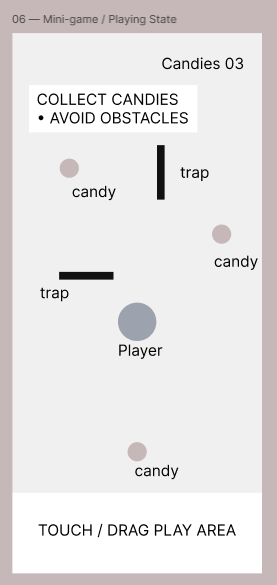
To test the experience loop, I designed one representative attraction: a short, snake-inspired arcade challenge in which the visitor guides Pumpkin through a Halloween environment, collects candies and avoids obstacles. The familiar mechanic tests how play produces achievement and visible Living Park progression—not every future attraction.
Pumpkin is an independently created placeholder used to demonstrate the interaction. It is not an official Under the Castle character or a proposed final character design.
Representative interaction
01
01 — Navigate
Guide Pumpkin
Move through the attraction while avoiding obstacles.
02
02 — Collect
Gather candies
Collect items that record participation and can distinguish performance.
03
03 — Complete
Reach the core objective
Finish the accessible objective to move the journey forward.
04
World response04 — Progress
See the park respond
Return to a changed Living Park where the completed attraction and next route become visible.
Interaction rule
Completion moves the visitor forward; performance changes the outcome.
Prototype boundary
The prototype does not define final scoring, difficulty, lives, failure and recovery, candy values or reward thresholds. This section tests only the relationship between interaction, completion and visible progress.
06 — Creative-direction research
Atmosphere with intent, not decoration.
Emotional hierarchy
Mischievous playfulness leads. Spooky mystery provides atmosphere. Premium is expressed through execution and curation—not through mandatory luxury motifs.
Research method
I organized Pinterest references in FigJam by the decision each reference could inform—not by surface similarity.
Keep / Avoid
Keep
Expressive visible linework
Crooked, organic and recognizable forms
Layered but readable environments
Controlled darkness and theatrical light
Environmental storytelling and selective luminous accents
Purposeful retro-digital interaction moments
Avoid
Generic glossy or mobile-game rendering
Full-world pixel art or persistent CRT/VHS styling
Photorealistic, threatening or excessively dark horror
Childish Halloween novelty decoration
Ordinary attractions with Halloween symbols added
Literal reproduction of UTC characters, artwork or architecture
Originality and IP
I translated broad visual principles from existing UTC material without reproducing its specific characters, architecture, compositions, logos or proprietary artwork. The representative characters shown in this concept are placeholders created to demonstrate the proposed digital experience. Any official brand or IP use would require TEAM WANG’s approval and collaboration.
07 — Color and typography system
Finding a system between clarity, character and 1994.
Color architecture
01
World foundation
Dark values establish atmosphere and continuity across the Living Park.
Near Black#221F23Selected
Charcoal#3E3B3FWorking value
Black Green#001C00Selected
Deep Green#02430ASelected
02
Guidance and feedback
UTC Green#02AD02Selected
UTC Green connects illumination, navigation, progress and feedback.
03
Attraction identity
Each attraction receives one restrained dominant accent without replacing the shared dark world.
Pumpkin Orange#FF8A00
Haunted Purple#7A3CFF
Ghostly Cyan#00E5FF
Neon Pink#FF4DD2
Candle Yellow#FFD166
04
Readable contrast
Bone White supports readable text and interface surfaces against the dark foundation.
Primary contrast pair
REVEALED ROUTE
Bone White on Near Black
ENTER THE PARK
Near Black on Bone White
Bone White#EDEDEDSelected
Near Black#221F23Selected
Example application balance
60–70% · World foundation
10–20% · UTC Green
10–20% · Attraction accent
Approximate visual-direction guide—not a fixed production formula.
Build one shared world
Dark values dominate; accents stay restrained.
Guide with green
Green carries guidance and feedback—not decoration.
Differentiate selectively
One dominant accent identifies each attraction; color never communicates state alone.
Portfolio surface colours frame the case study; they are not part of the UTC product palette.
Typography — three voices
Three voices separate clarity, environmental character and digital feedback.
01
Interface voice
Selected · Instrument Sans
Enter the Living Park
Role Navigation, instructions, controls and body content.
02
World voice
Selected · Underdog
Follow the light
Role Attraction names, environmental signs and physical-world messages.
03
Digital voice
Final evaluation · Pixelify Sans / VT323
The final digital voice will be selected inside representative feedback and completion states.
Pixelify Sans
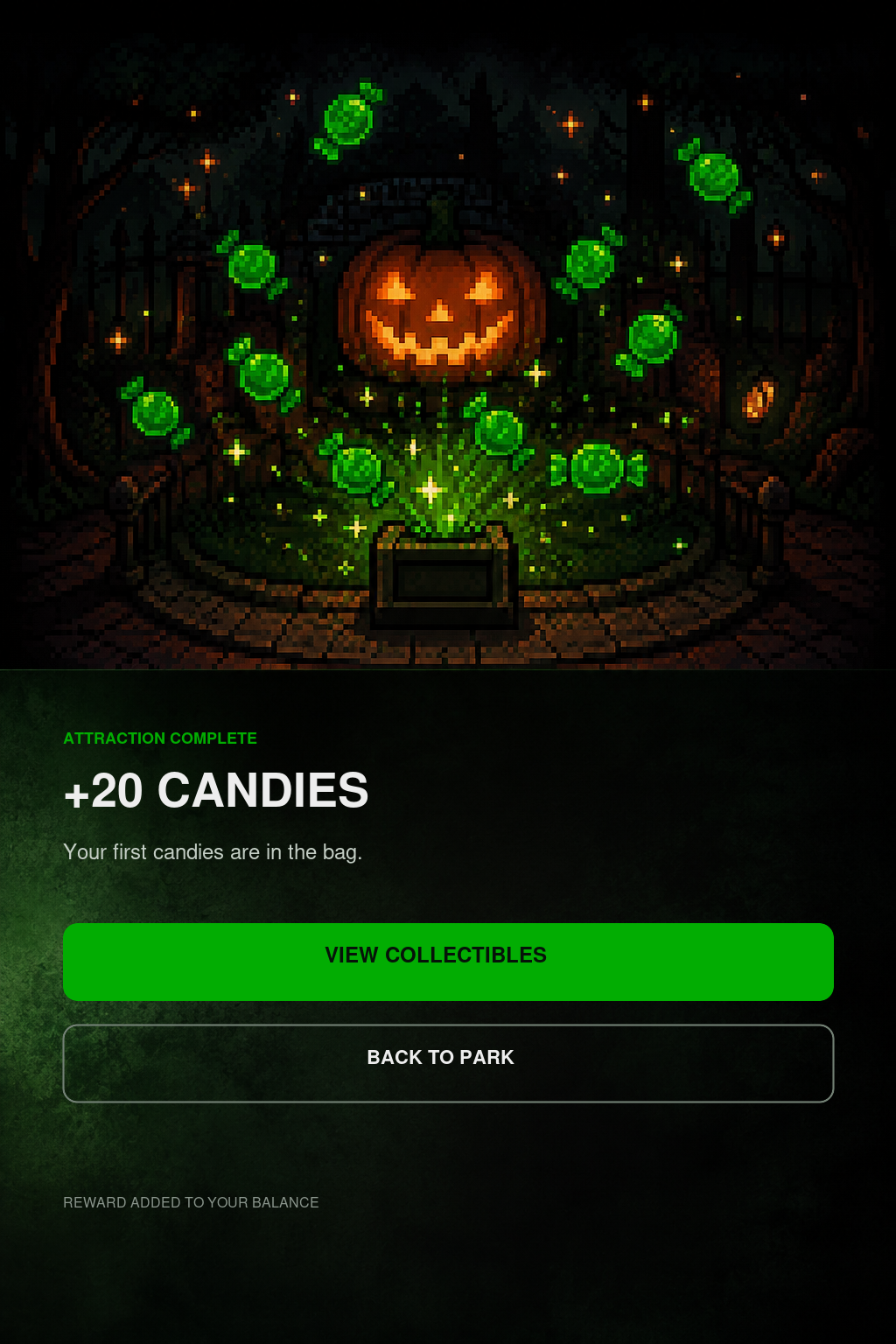
ATTRACTION COMPLETE
+20 CANDIES
Rounded and contemporary, with a closer relationship to the physical-world character.
VT323
ATTRACTION COMPLETE
+20 CANDIES
More terminal-like and historically specific, but less directly connected to the illustrated world.
Read in Instrument Sans. Discover in Underdog. Receive feedback through a selective digital voice.
Boundaries
Comic utility, fashion-first contrast and full-interface pixel typography were rejected because each allowed one visual characteristic to overpower the wider world.
08 — Visual decisions and application
The visual direction was built through decisions.
I developed the visual direction through research, art-direction briefs, AI-assisted exploration, selection, iteration and interface composition. These refinements are design judgments—not user-tested findings.
Four visual refinements
01
Readability in darkness
Issue
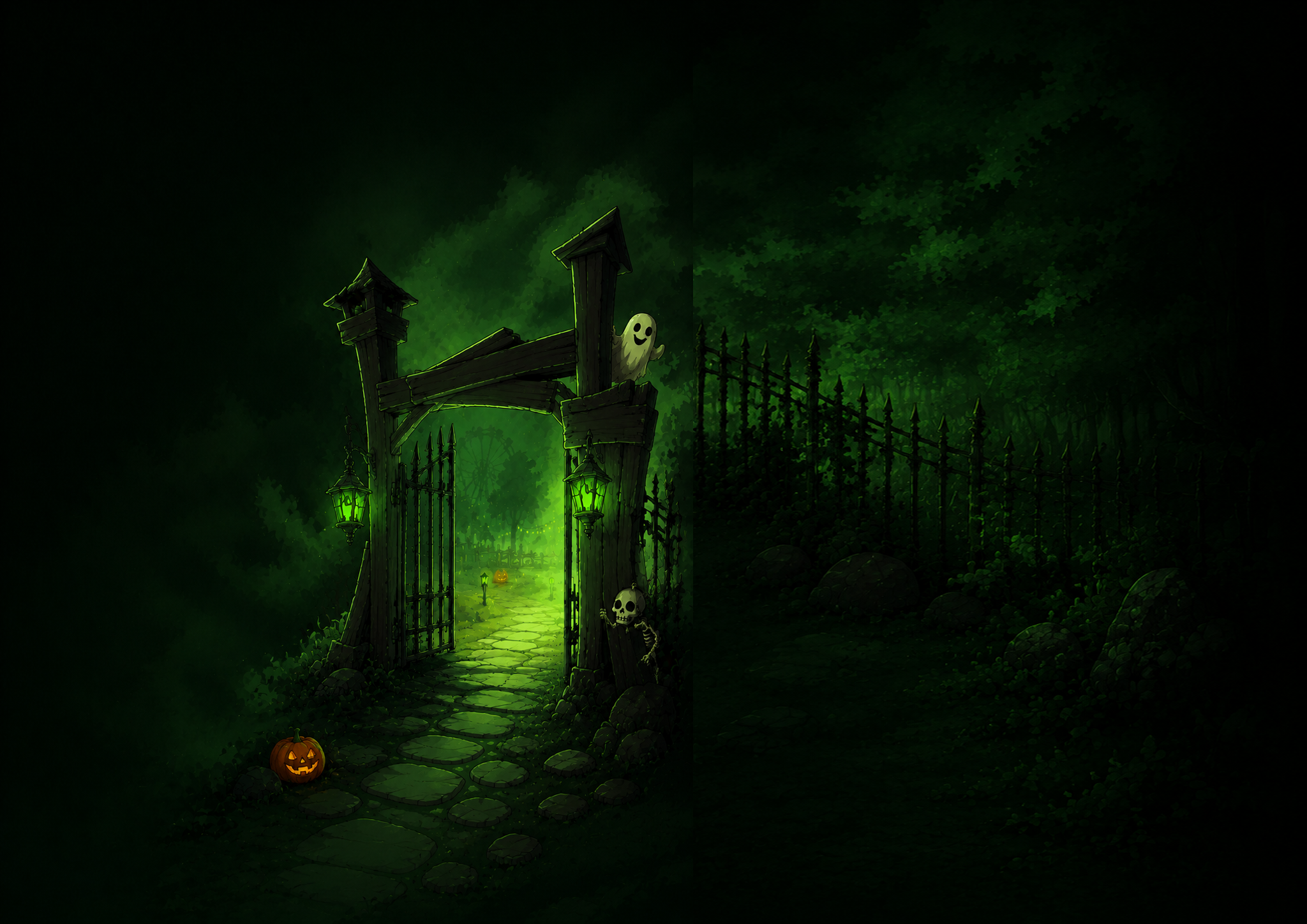
Early compositions were too dark, making the gate and necessary destinations difficult to understand.
Change
I refined the lighting and localized the fog around important landmarks and the active route.
Effect
Preserve mystery while giving essential navigation points a clear theatrical focus.
02
Composition and immersion
Issue
Moving the gate aside created space for a separate interface panel, but made the experience feel like a website placed beside a backdrop.
Change
I rejected the divided composition and integrated interface elements into the environmental scene.
Effect
Make the interface feel like part of the experience rather than a layer placed next to it.
03
Inhabited, not staged
Issue
Pumpkins, ghosts and skeletons initially appeared arranged like props prepared for a photograph.
Change
I dispersed them throughout the environment and treated them as parts of the world.
Effect
Create a park that feels inhabited, playful and lived-in.
04
Expressive without noise
Issue
Excessively curly forms introduced visual noise while attempting to create irregularity.
Change
I simplified the forms while preserving crooked construction, dramatic illumination, localized fog and playful detail.
Effect
Keep the world expressive without compromising recognition or navigation.
Applying the direction
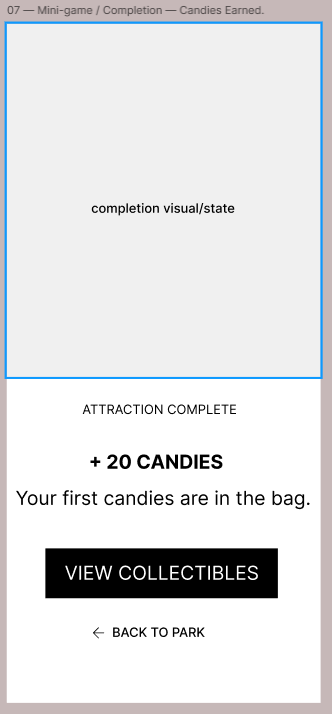
World-level applicationControlled illumination, localized fog and integrated environmental details make the entrance readable without removing its mystery.Interface-level applicationAchievement is confirmed first, followed by a deliberate choice between viewing collectibles and returning to the park.
09 — Representative prototype
Prove the decisions through selected moments.
The prototype combines high-fidelity visual moments with simplified flow states to demonstrate product logic—not to present every screen as production-ready.
Structuring the vertical slice
01
Enter
Attraction entry
View frame
02
Play
Gameplay
View frame
03
Complete
Completion
View frame
04
Progress
Park response
View frame
05
Choose
Collectibles
View frame
The representative journey in high fidelity
01First visit
Available destination
02Completion
Achievement confirmed
03Changed park
World response
04Collectibles
Optional eligibility
Candy totals and eligibility thresholds are illustrative prototype values used to communicate system states—not a finalized reward economy.
10 — Scope and fidelity
Enough to test the idea. Not the entire product.
Designed in the representative prototypeCore journey
Entry, one playable attraction and completion.
Visible world response
Completion changes the Living Park and reveals the next route.
Optional ownership preview
Achievement is confirmed before visitors can explore collectible eligibility.
Intentionally unresolvedComplete game system
Additional attraction mechanics, failure and recovery, exact scoring, candy values, performance thresholds and final eligibility rules.
Accounts and persistence
Accounts, saved progress and inventory synchronization.
Commerce and availability
Checkout, payments, tax, fulfilment and regional availability.
Production and governance
Final technical architecture, production accessibility validation and implementation, and official brand or IP integration.
The prototype makes the central proposition reviewable without presenting production-dependent systems as completed decisions.
11 — Validation and reflection
What remains open— and what I learned.
The following are design reflections and validation priorities—not tested findings.
Reflection
01
The central strategic tradeoff
Expanding participation was only valuable if the digital experience preserved the scarcity, anticipation and atmosphere that distinguish the physical event—leading me to treat UTC Digital as a parallel experience rather than a reproduction.
02
Why the representative slice worked
One complete attraction inside a responsive Living Park made the proposition tangible without implying a finished game or commerce platform.
Prioritized validation plan
01First
Comprehension and participation
Can visitors understand the invitation, begin confidently and recognize how their actions affect the Living Park?
02Then
Progression and independent value
Do achievement, earned access, world response and continued play feel meaningful without a collectible purchase?
03Later
Commercial and operational viability
Only after the experience proposition is understood should admission, pricing, reward structures and production-dependent systems be evaluated.
Final product insight
Participation creates the value; commerce follows achievement.